


Event report
April 13, 2026
FabCafe Global Editorial Team
When something people use every day breaks down, they face a choice: repair it or throw it away and buy a new one. It is a decision many people face more often than they realize.
There was a time when repairing something and using it until it wore out felt completely normal. Today, that impulse is no longer instinctive. Repair can feel like more trouble than it’s worth. Many people do not know how to fix things themselves. Replacing an item often seems cheaper and faster. Some may not even know whether repair is possible in the first place. Without realizing it, people are drifting further and further from the habit of repairing things.
In the United States, debate over the right to repair gained traction in the 2010s as questions about ownership came into sharper focus. The issue centered mainly on cars and digital devices, where manufacturers were seen as limiting users’ freedom to repair what they owned. Backed by consumer advocacy and civic pressure, reform efforts began gaining momentum. In Europe, the shift toward a circular economy pushed repair into the spotlight. France introduced a repairability label(*1), and the European Union adopted its Right to Repair Directive(*2).
These shifts in the U.S. and Europe show that repair is no longer just a technical issue. It has become a social one.
*1 France’s repairability label: Mandatory in France since 2021, the system requires consumer electronics and home appliances, including smartphones and washing machines, to display a repairability score on a scale of 1 to 10. The goal is to help consumers choose products based on whether they can be repaired and maintained over time. It also encourages manufacturers to design products that are easier to fix.
*2 The European Union’s Right to Repair Directive: Adopted by the EU in 2024, the directive requires manufacturers to repair products even after the warranty period ends, as long as repair is technically possible. The law frames repair and long-term use as a legitimate consumer right, pushing back against a throwaway product culture. It also aims to reduce environmental impact.
In light of this, FabCafe Tokyo has been paying close attention to the Repair Cafe movement, which began in Amsterdam, the Netherlands, in 2009.
A Repair Cafe is a place where people bring broken appliances, clothing, bicycles and other everyday items. Local repairers help fix them or teach people how to repair things on their own. What began as a local initiative has grown into a global movement with more than 3,500 locations worldwide. In Japan, organizations and companies practicing circular design have also started opening repair spaces for local communities. Why are these repair efforts attracting so much attention now?
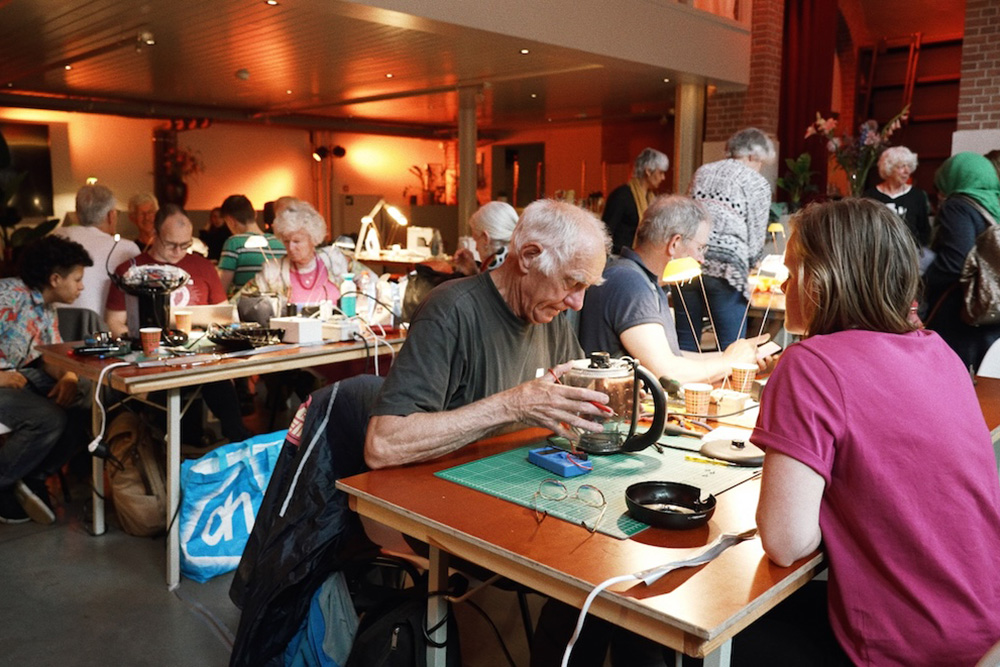
Scenes from a Repair Cafe in Amsterdam, the Netherlands, from the film Repair Cafe. Credit: IDEAS FOR GOOD.
On Dec. 17, 2025, FabCafe Tokyo hosted a screening of the documentary Repair Cafe, which looks closely at the Repair Cafe movement in Amsterdam, the Netherlands. It also held a panel discussion featuring people who are putting repair into practice within businesses.
Using the Repair Cafe movement as a starting point, the event explored how individuals and businesses can work together to build a lasting culture of repair and reuse. The conversation offered insights into how repair can restore personal histories and rebuild community ties.
Trailer for the documentary “Repair Cafe” by IDEAS FOR GOOD
Daiki Kanaoka, chief technology officer and chief operating officer of FabCafe Tokyo, explained why FabCafe Tokyo is interested in repair and in the Repair Cafe movement.
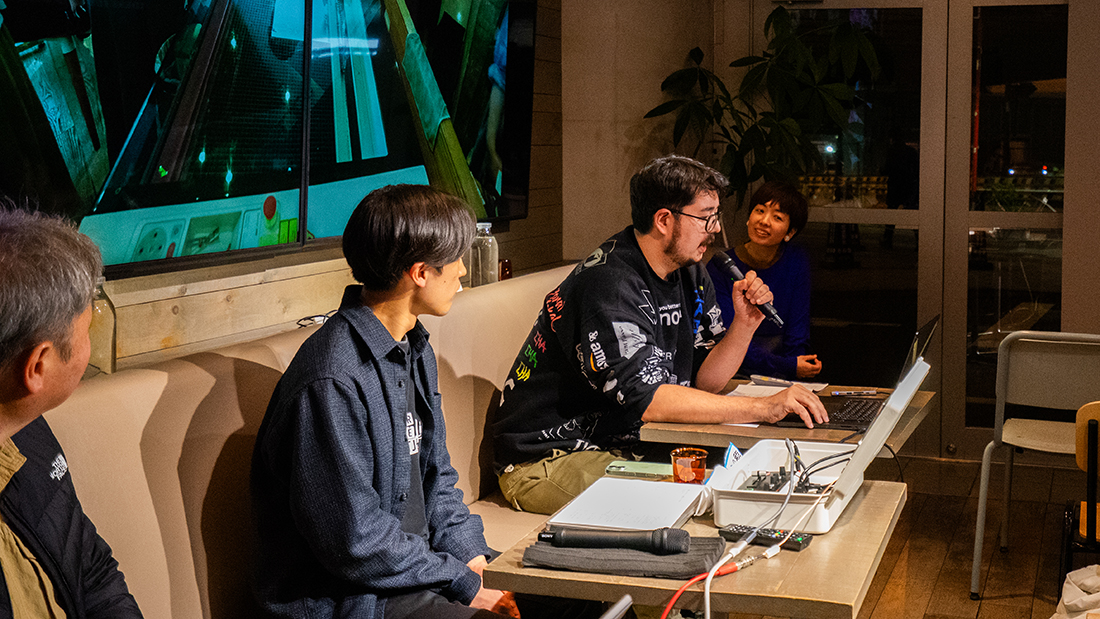
Daiki Kanaoka, CTO of FabCafe Tokyo, second from right, and Eri Iwasawa, Loftwork Inc. Culture Executive, who planned the event, right.
As technology becomes more advanced, it also becomes more of a black box, almost as if it were magic. Repair means directly engaging with an object and the technology inside it.
People do not have to remain passive in the face of the technology around them. They can open the black box and engage with it more actively. From the perspective of opening up technology, FabCafe sees repair as a theme it wants to stay involved with over time.
The event also showed how repair can help people regain a sense of agency over the technology in their lives.
During the panel discussion, Masato Sezawa of IDEAS FOR GOOD, director of the film Repair Cafe, joined the stage. The conversation began with why he made the film and how the repair movement spreading across Europe might be adapted to Japanese culture.
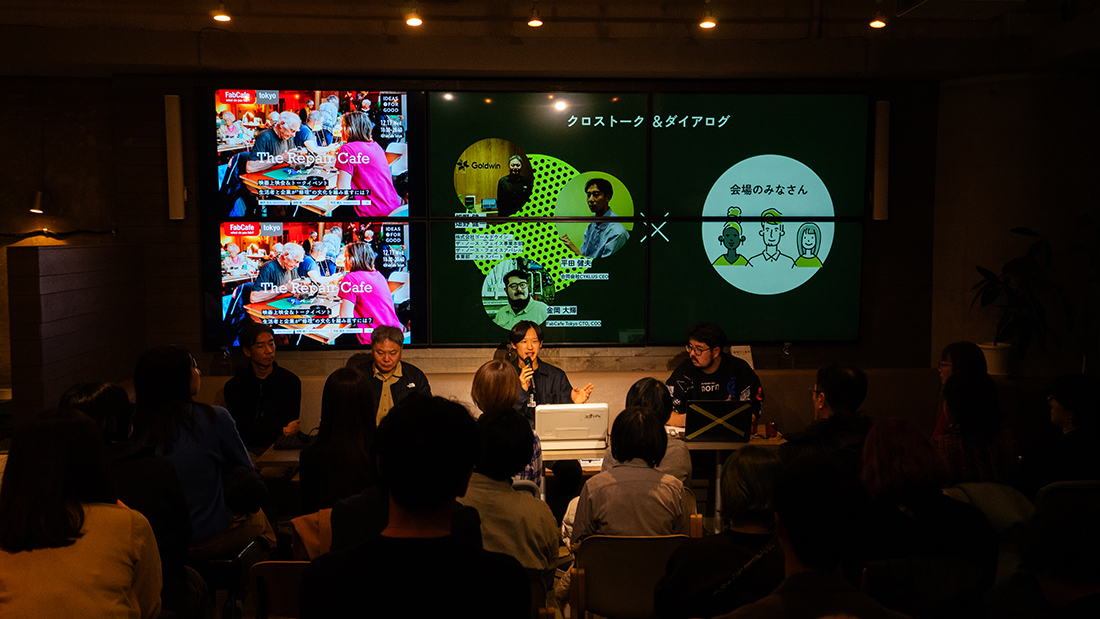
Panel discussion speakers, from left:
・Takeo Hirata, CEO of CYKLUS LLC
・Kenichi Hatano, expert in the The North Face Apparel Department, The North Face Business Unit, Goldwin Inc.
・Masato Sezawa, creative director at IDEAS FOR GOOD
・Daiki Kanaoka, chief technology officer and chief operating officer of FabCafe Tokyo
Daiki Kanaoka, FabCafe Tokyo: The film Repair Cafe really touched on the roots of what repair means. What inspired you to make it?
Masato Sezawa, IDEAS FOR GOOD: It started about three years ago, when I met Peter, who runs a Repair Cafe in the Netherlands. On my first visit, I saw a man in a wheelchair carefully carrying an old wall clock. Watching Peter work on it, I realized he wasn’t just fixing the clock. He was restoring the owner’s memories along with it.
As filming continued, I realized repair wasn’t only about memory. It was also about community. In cities, where loneliness affects so many people, Repair Cafes help restore local connections. And it was about the planet, too. In a linear economy built on mass production and mass consumption, repair reconnects the broken loop of resource circulation.
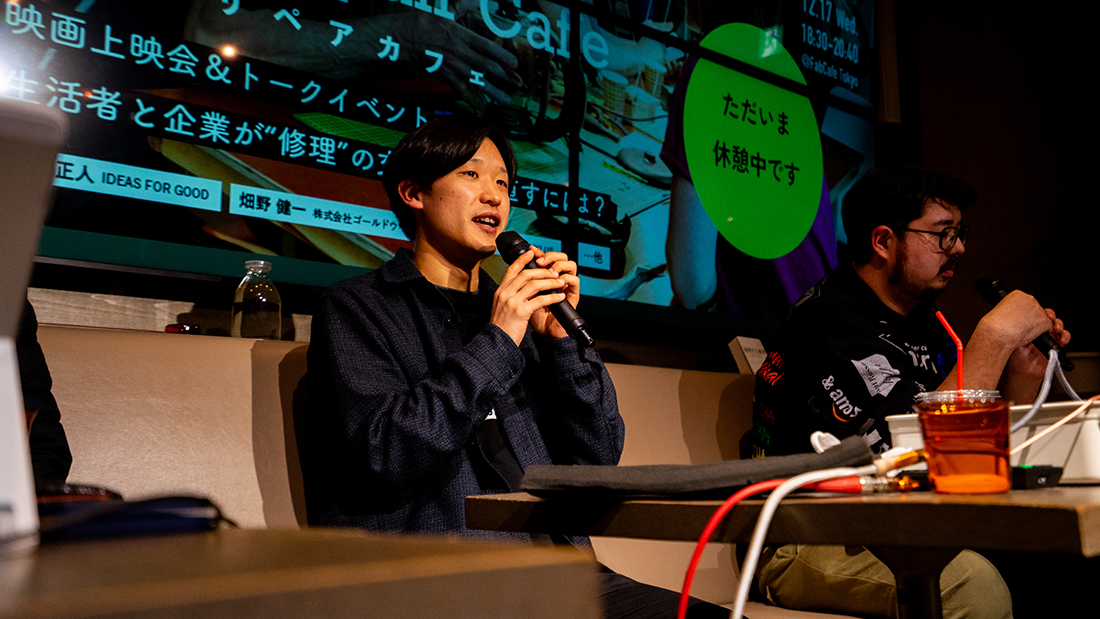
Masato Sezawa of IDEAS FOR GOOD, director of the documentary Repair Cafe.
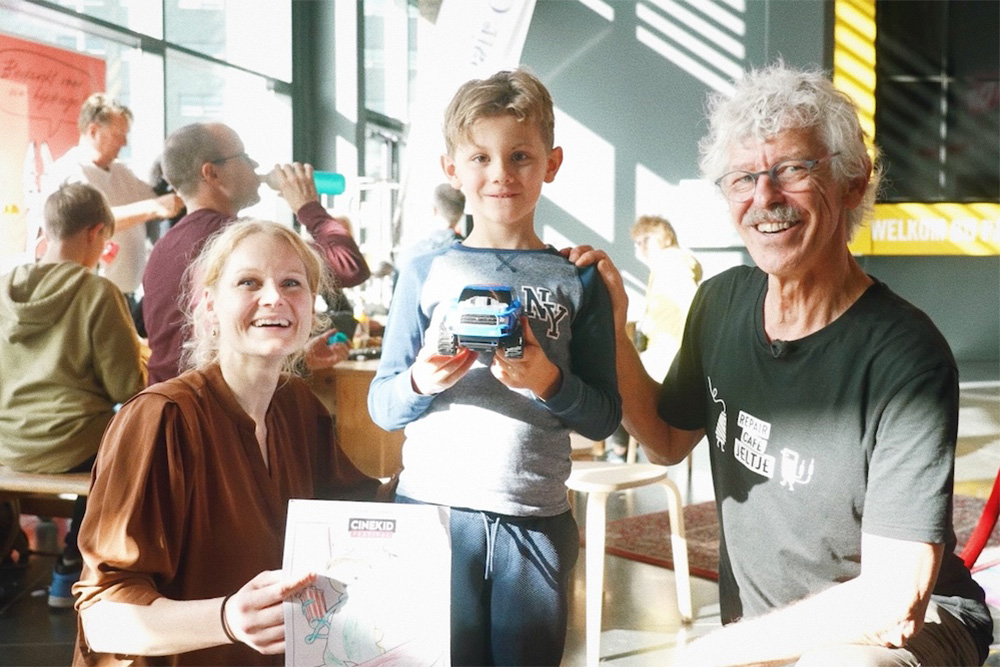
There are also Repair Cafes for children, where toys are repaired. From the film Repair Cafe. Credit: IDEAS FOR GOOD.
Kanaoka: The global spread of Repair Cafes seems closely tied to the right to repair movement, especially in Europe. In Japan, however, many say there is still little momentum around the issue. If Japan is to adapt the repair and Repair Cafe movement, what perspectives matter most?
Sezawa: In the Netherlands, the logic behind not wasting things is very straightforward. If only one part is broken, throwing away the whole object feels irrational. In Japan, people often relate to objects with a sense that they carry life, spirit, or presence, as seen in ideas such as yaoyorozu no kami, the belief that countless spirits dwell in all things. People may feel sadness or guilt when throwing something away. By drawing on this uniquely Japanese sense of attachment and emotion, Japan may be able to build a repair culture that is not just a copy of Europe or the U.S.
The conversation then expanded to include Kenichi Hatano of Goldwin Inc. and Takeo Hirata of CYKLUS LLC. Together, they introduced DO REPAIRS, a project that crosses brand boundaries.
Kanaoka: In DO REPAIRS, apparel brands that would normally compete are working together around a shared commitment to repair. How did the project begin?
Kenichi Hatano, Goldwin Inc.: GOLDWIN has never been a company focused on making huge volumes of cheap products. It values creating good products that people can use for a long time. DO REPAIRS began as a way to act on that value by partnering with competing brands and putting out a unified message about repair. The first edition started on Cat Street in Harajuku, Tokyo, with three brands: THE NORTH FACE by Goldwin, Patagonia and FREITAG.
Takeo Hirata, CYKLUS LLC: At the time, I was working at Patagonia. When Hatano asked if we’d like to join, I said yes immediately. I believed that working together to build a culture of longer use and care would have a bigger impact on society than any one company acting alone.
Hatano: What was interesting was that the project began with three companies, but nearby brands started saying they wanted to join too. In the most recent event, more than 20 groups took part. It had grown into something much larger than we imagined.
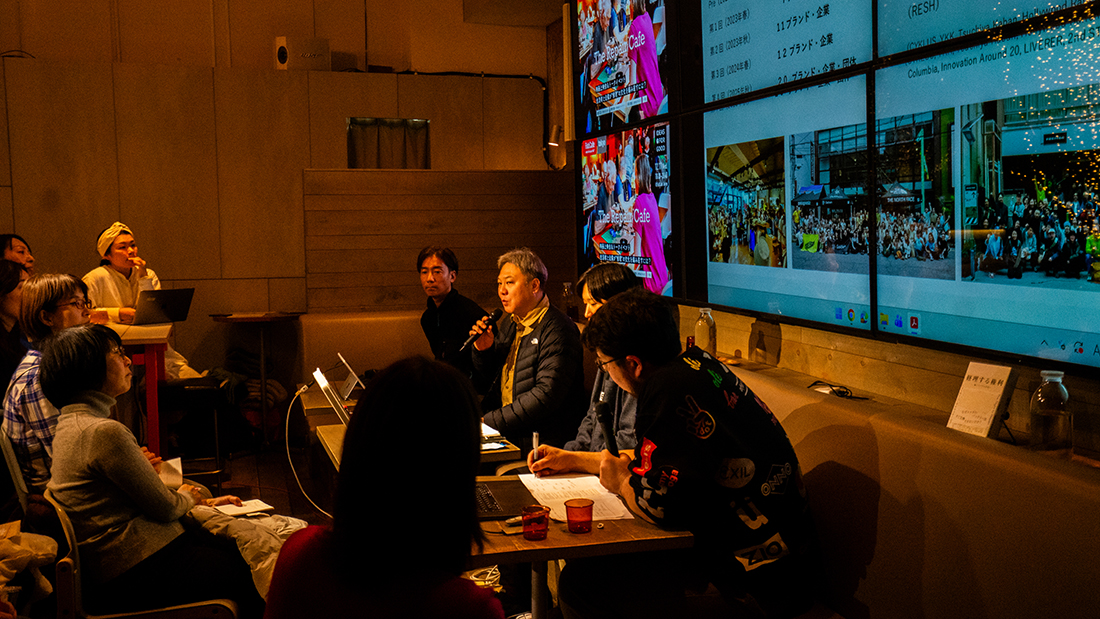
Kenichi Hatano of Goldwin, center, one of the initiators of DO REPAIRS.
Kanaoka: What kind of changes did participants and people around the project experience?
Hatano: I heard that factory workers from our facility in Toyama who rarely interact with customers joined the event and were thanked directly by the people they’d helped. That experience dramatically boosted their motivation.
Hirata: It was similar to Patagonia. A standout moment came when repair staff from different brands started swapping techniques. They asked how others approached certain repairs and shared their own methods. That felt like the moment a real community started to form.
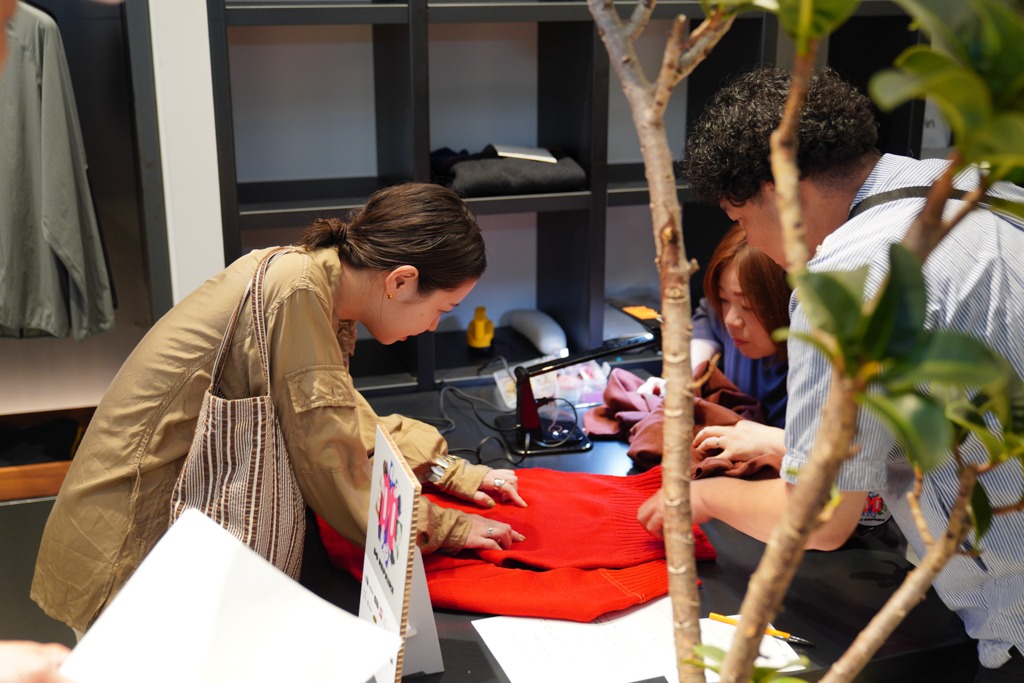
At the storefront, customers and repair staff worked together to decide how each repair should be done. Credit: DO REPAIRS.
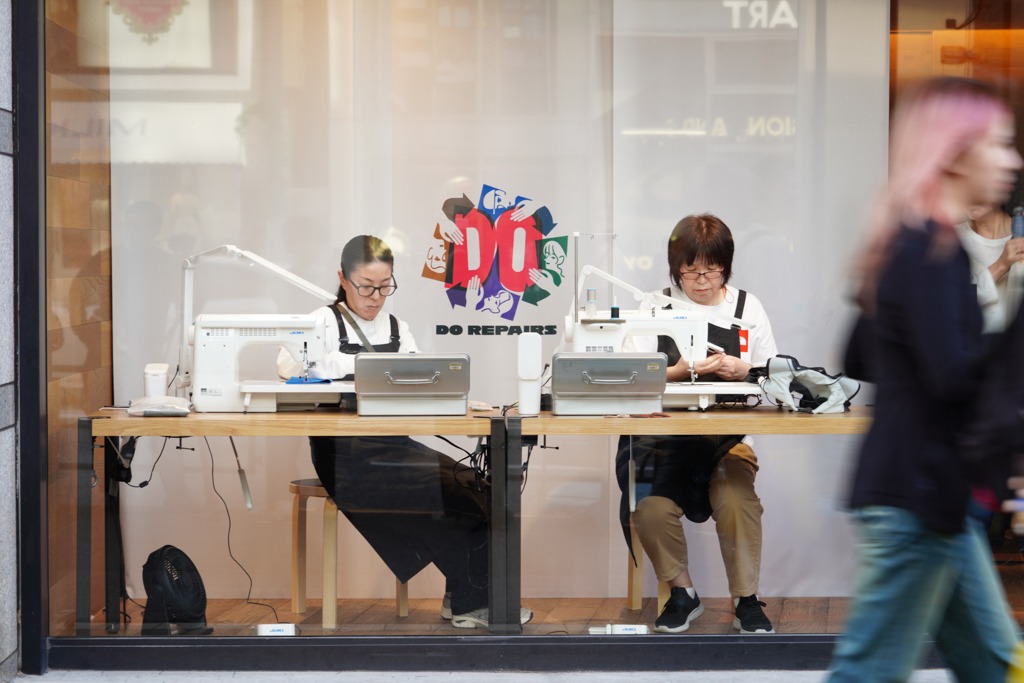
Creating street scenes where repair becomes visible is one of the unique strengths of DO REPAIRS. Credit: DO REPAIRS.
Kanaoka: To expand the repair movement further, it seems essential to involve a wider range of players. Younger generations, in particular, may have an important role to play.
Hirata: Through a demonstration project run by Japan’s Ministry of the Environment called Community Loops, we once collaborated with universities in which students led the planning of a Repair Cafe. Their creativity was striking. One group, for instance, transformed secondhand clothing into decorative patches and incorporated them into repairs. Many fresh ideas emerged. For younger generations, choosing secondhand clothing already feels natural. There also seems to be a growing desire to repair items inherited from parents.
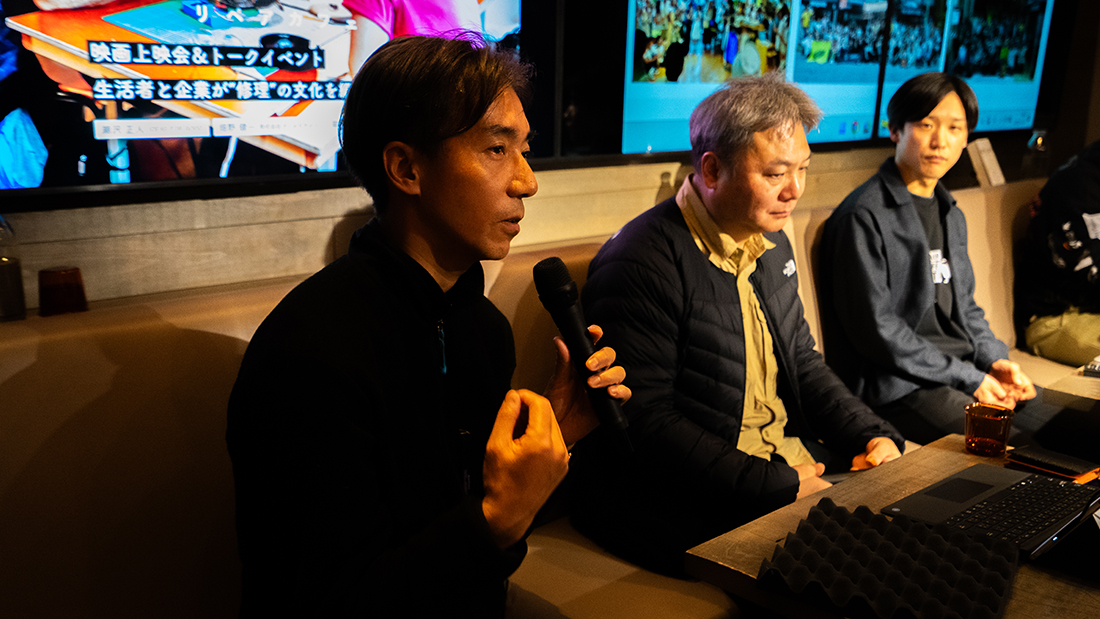
Takeo Hirata of CYKLUS, left.
Sezawa: I’ve also brought screenings of Repair Cafe to different places. At some of those screenings, members of Gen Z were moved to tears. Repair Cafes offer a sense of belonging. Even people who have no repair skills at all feel welcome there. That form of acceptance seems to resonate with younger people. Perhaps they’re also burned out on digital connections and are looking for communities that feel grounded and real.
Kanaoka: If repair is to create a wider impact, business sustainability also matters. Audience members asked how companies can balance profit and cost.
Hatano: To be honest, it can be difficult for a company to make repair profitable on its own. Still, by using repair initiatives to support a shift toward products made to last, companies can strengthen brand value. That may require moving away from a model based on selling cheap products in large volumes.
Sezawa: Data from Philips in the Netherlands shows that investing more in repair and refurbished products deepened customer engagement. Loyalty improved and sales also benefited. Repair can become a powerful way to build lasting relationships with customers.
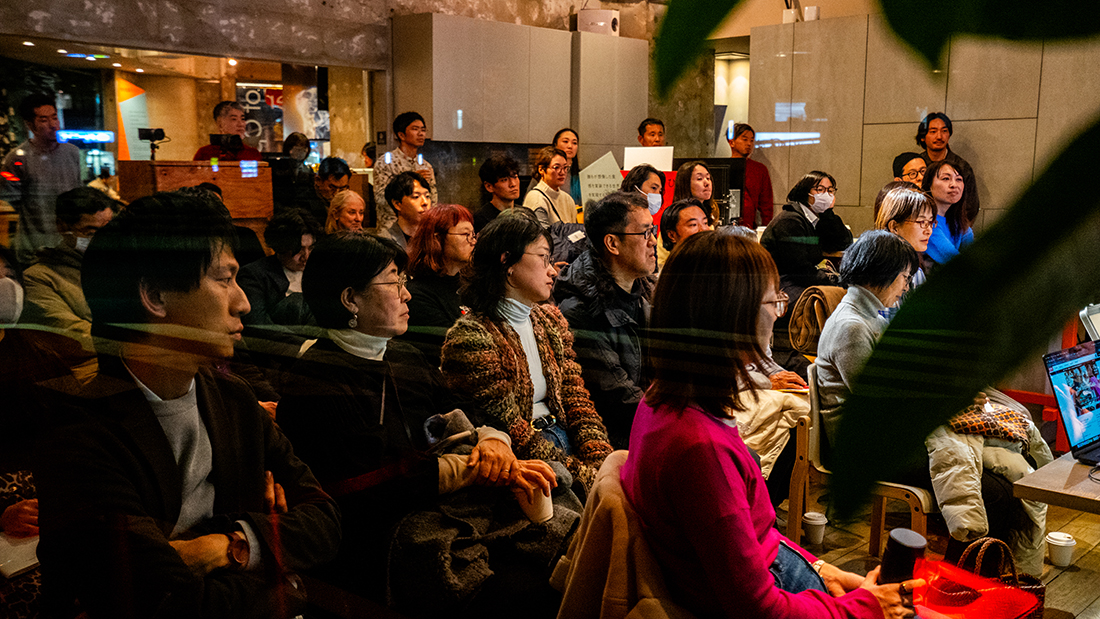
Kanaoka: From the perspective of public institutions, what kinds of support or involvement would help?
Hatano: One option would be for the government to certify companies that are actively practicing repair or establish award programs to recognize them publicly. That kind of support could encourage more companies to take action.
Sezawa: Repair Cafes also have the power to reconnect communities. More municipalities are paying attention to them as a way to strengthen local resilience. To keep these efforts from fading as a temporary trend, there is a need for intermediary organizations that can connect businesses, government and citizens, while making the value of repair more visible and easier to share. In the future, it may be possible to imagine repair hubs in places like libraries and train stations, where repair functions as part of everyday infrastructure.
For companies, repair is not an easy path when viewed only through the lens of business sustainability. Yet once attention shifts to its nonfinancial value, a wide range of possibilities begins to appear. A commitment to making durable products and helping people use them for longer can strengthen a brand. Repair efforts that grow through corporate collaboration can also foster pride among employees and create solidarity that crosses organizational lines.
The global spread of Repair Cafes has not been driven only by sustainability or by the right to repair. For the people who take part, the value goes beyond simply fixing objects. Repairing something together creates opportunities for people to form genuine connections through shared, hands-on experience. The examples shared during the panel discussion suggested that these repeated experiences can even help bring energy back to communities that have begun to lose their connections.
Caring for objects, using them longer and passing on the knowledge of how to do so can rebuild forms of connection that established institutions have struggled to maintain. As this kind of movement grows, it may also have a major impact on a more circular future for society and the economy. The evening left a strong sense that even a small act like repair can open up new possibilities for the future.
Written and edited by: Ryoko Iwasaki, FabCafe Tokyo
Translated by: Pinhua Chen


-
FabCafe Global Editorial Team
This articles is edited by FabCafe Global.
Please feel free to share your thoughts and opinions on this article with us.
→ Contact usThis articles is edited by FabCafe Global.
Please feel free to share your thoughts and opinions on this article with us.
→ Contact us -


See Branch List
See Keyword List
- #Craft
- #crQlr
- #HK Event Report
- #COUNTER_POINT
- #Prototyping
- #Design thinking workshop
- #SDG 14 Life under water
- #Miro
- #Creator Collaboration
- #Bangkok Design Week 2020
- #FabCafe Bangkok
- #Fab Meetup Hong Kong
- #FAB Ideation
- #Future City
- #COVID-19
- #Event Report
- #Sustainable
- #Business
- #Social Welfare
- #Fab Meetup
- #Exhibition
- #Art
- #SDGs
- #Haptic Design
- #Material
- #Drawing
- #Wood
- #Hackathon
- #AI
- #Agriculture
- #YouFab
- #Workshop
- #Meetup
- #AWRD
- #Bio
- #Global Goals Jam
- #XR (VR/AR/MR)
- #Talk Event
- #Ideathon
- #Embroidery
- #Material Meetup
- #Innovation
- #Architecture
- #Interview
- #Education
- #3D
- #Business Projects
- #Community