


Column
August 30, 2026
FabCafe Global Editorial Team
The newly opened FabCafe Fukushima, currently located in Zutto Soko Inc. in the village of Iitate, is just under an hour east of JR Fukushima Station by car. This repurposed former home-improvement store operates as a physical community hub which frames the village of Iitate as a “living museum”. In this framing, there is an emphasis on planning and running tour programs which focus on sharing environmental, agricultural, and community based initiatives and their insights.
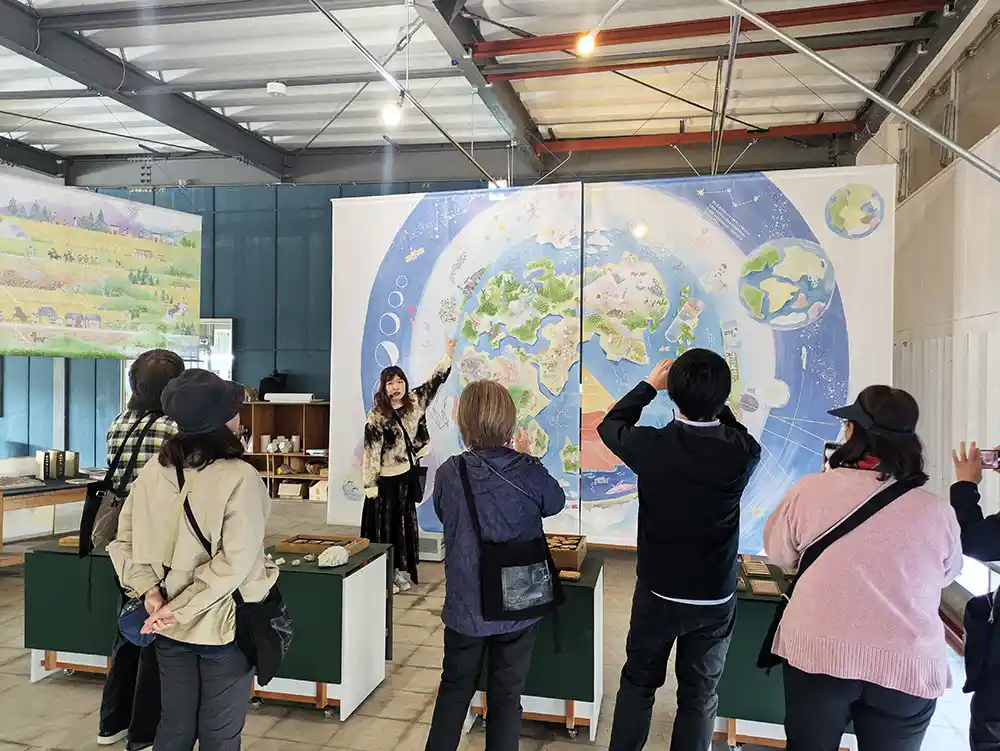 Jun Yano, Zutto Soko’s representative director and founder of FabCafe Fukushima, leading a tour
Starting at the community hub and FabCafe Fukushima’s base Zutto Soko, the group joined here for a walk through the permanent exhibition Traveling the Umwelt. The nuclear accident turned Iitate into an observation field for all kinds of environmental research to support inquiries into human-nature relationships and land stewardship. This exhibition frames environments from the scales of elementary particles all the way to the cosmos, and invites visitors to think about environments within multiple scales to guide audiences to think about multi-scale possibilities.
The tour then takes a step into an agricultural lens with Niku no Utopia. The owner Yutaka Yamada, had trained at a butcher shop while living as an evacuee in Kyoto and now runs a farm and butcher shop, working to bring back “Iitate beef” since the evacuation order was lifted.
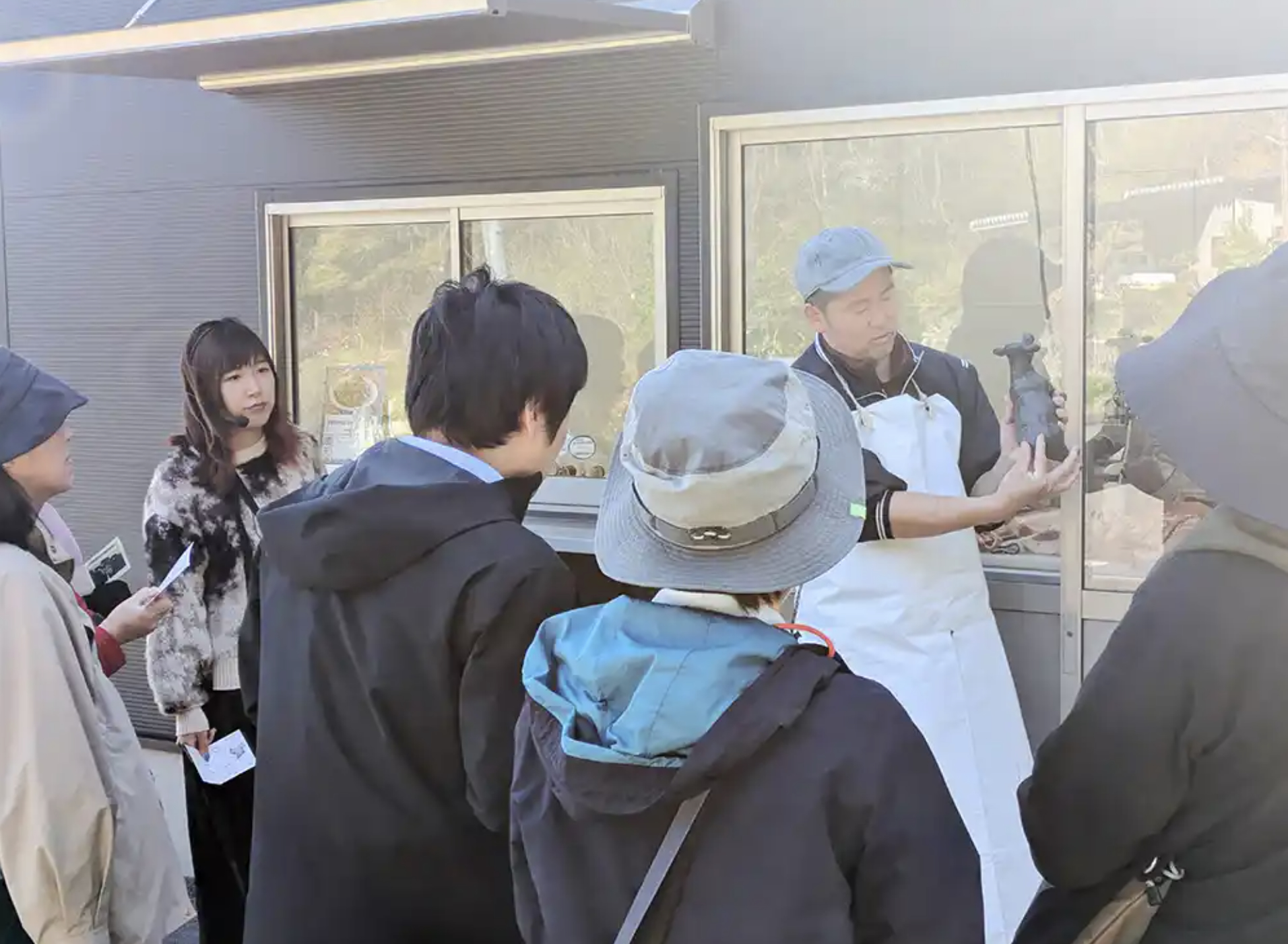
Yutaka Yamada of Niku no Utopia (back right) explaining his work
Buying meat from a farm-to-table butcher shop is not the only thing that sets Niku no Utopia apart. Since Yamada understands the importance of land stewardship in agriculture, he is pursuing a number of efforts to revitalize and maintain local ecologies.
Guests also get to experience this farm-to-table experience for dinner by tasting meat selected by Yutaka Yamada himself.
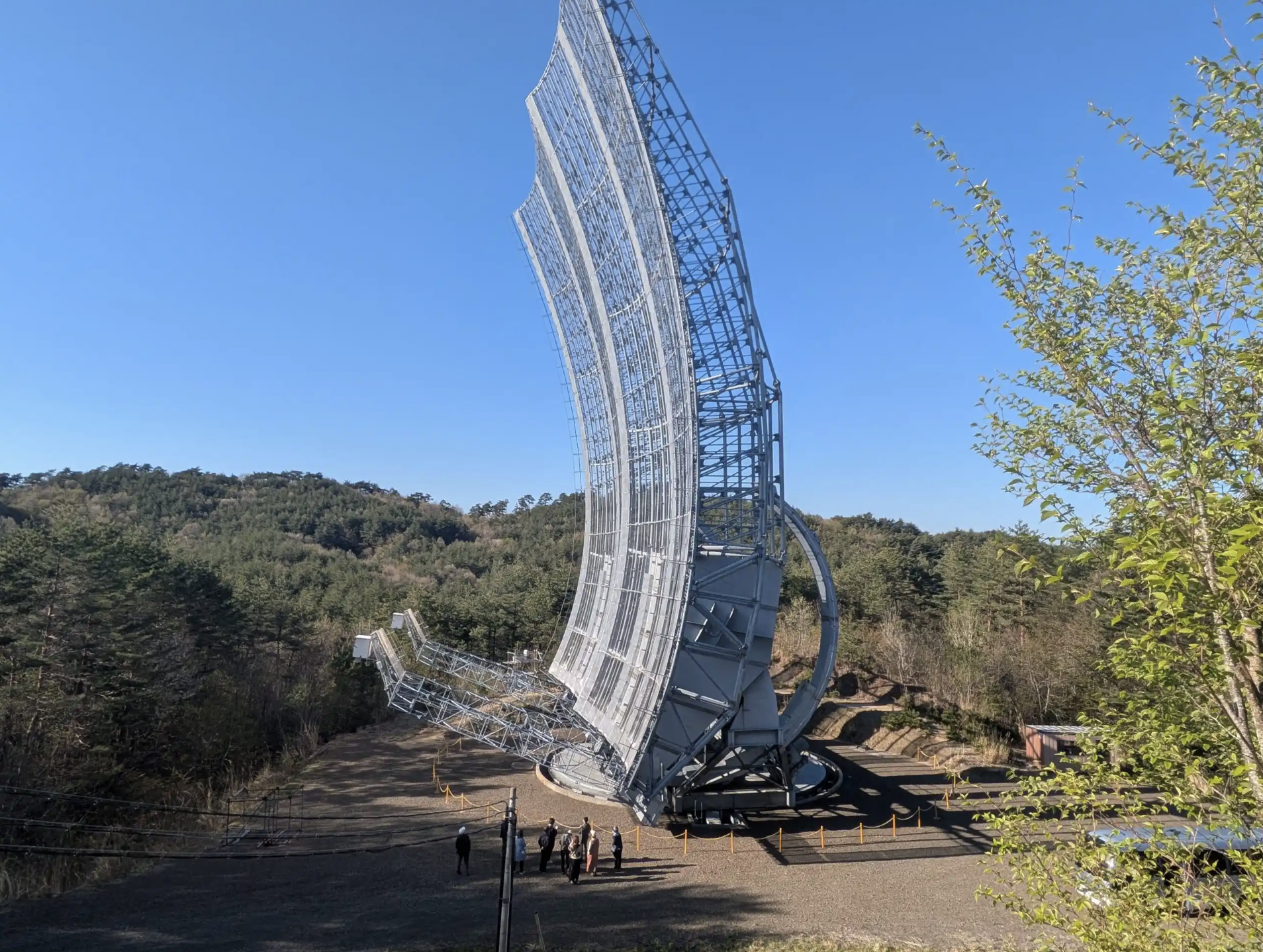
Listening to an explanation at the foot of the planetary radio telescope at the Iitate Observatory
From the very human scale of farm-to-table, came a more cosmic perspective from the Iitate Observatory of Tohoku University’s Planetary Plasma and Atmospheric Research Center. Set away from residential areas and less affected by radio waves from streetlights and human activity, the site is used to observe radio waves reaching Earth from space, including from Jupiter and the Sun. Standing beneath the large planetary radio telescope, the group heard from Hiroaki Misawa, Associate Professor at Tohoku University’s Graduate School of Science.
The observatory keeps capturing the radio waves that pour down onto the Earth’s surface in order to get a handle on the many phenomena occurring in space. Professor Misawa’s talk widened the sense of the world and brought home how inseparably the soil at the feet is connected to outer space.
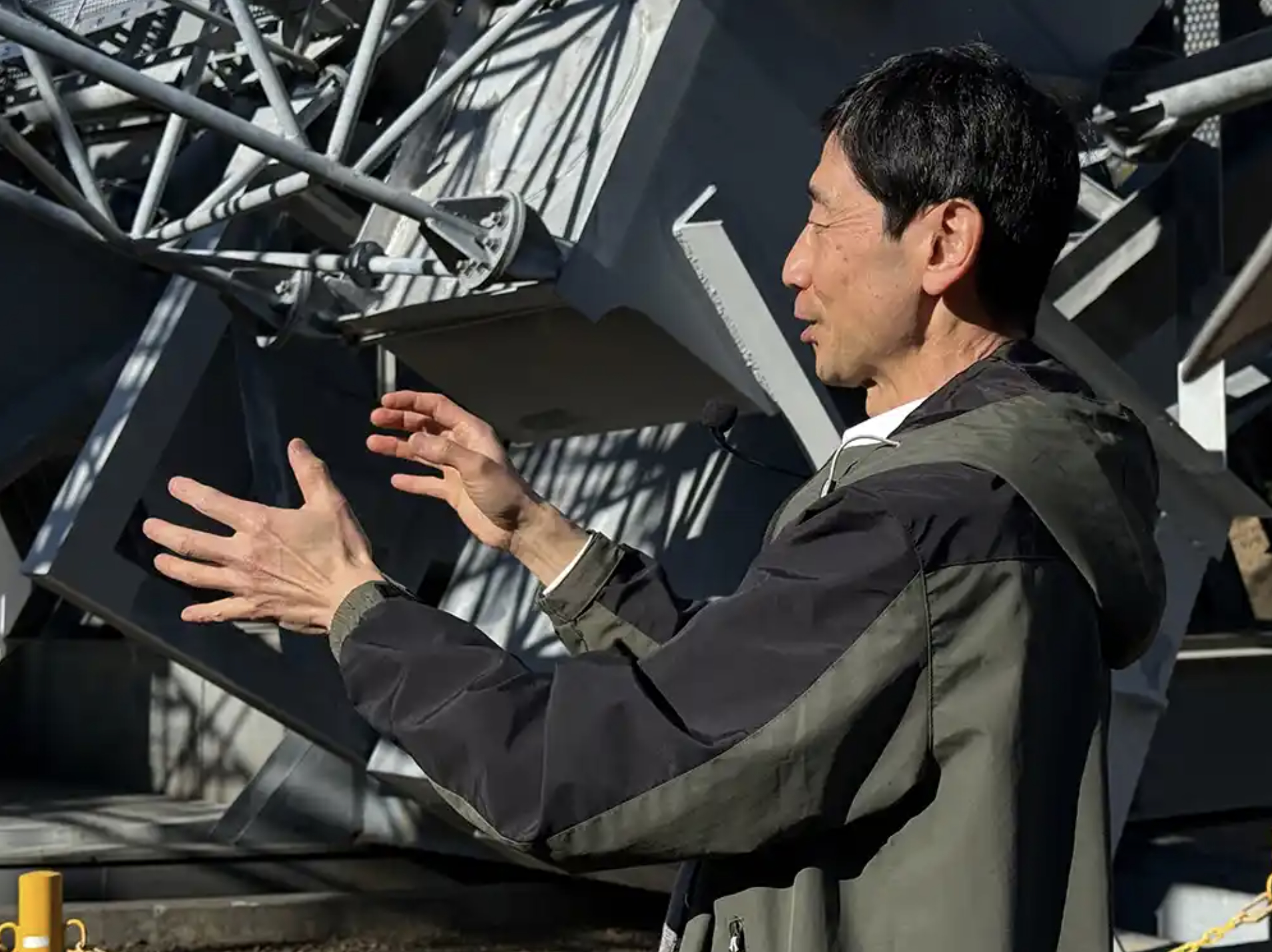
Hiroaki Misawa, Associate Professor, Graduate School of Science, Tohoku University
Upon leaving the observatory, the tour group checked in at the guesthouse Kikori where a teppanyaki style dinner centered around Iitate raised Japanese black beef under a full sky of stars.
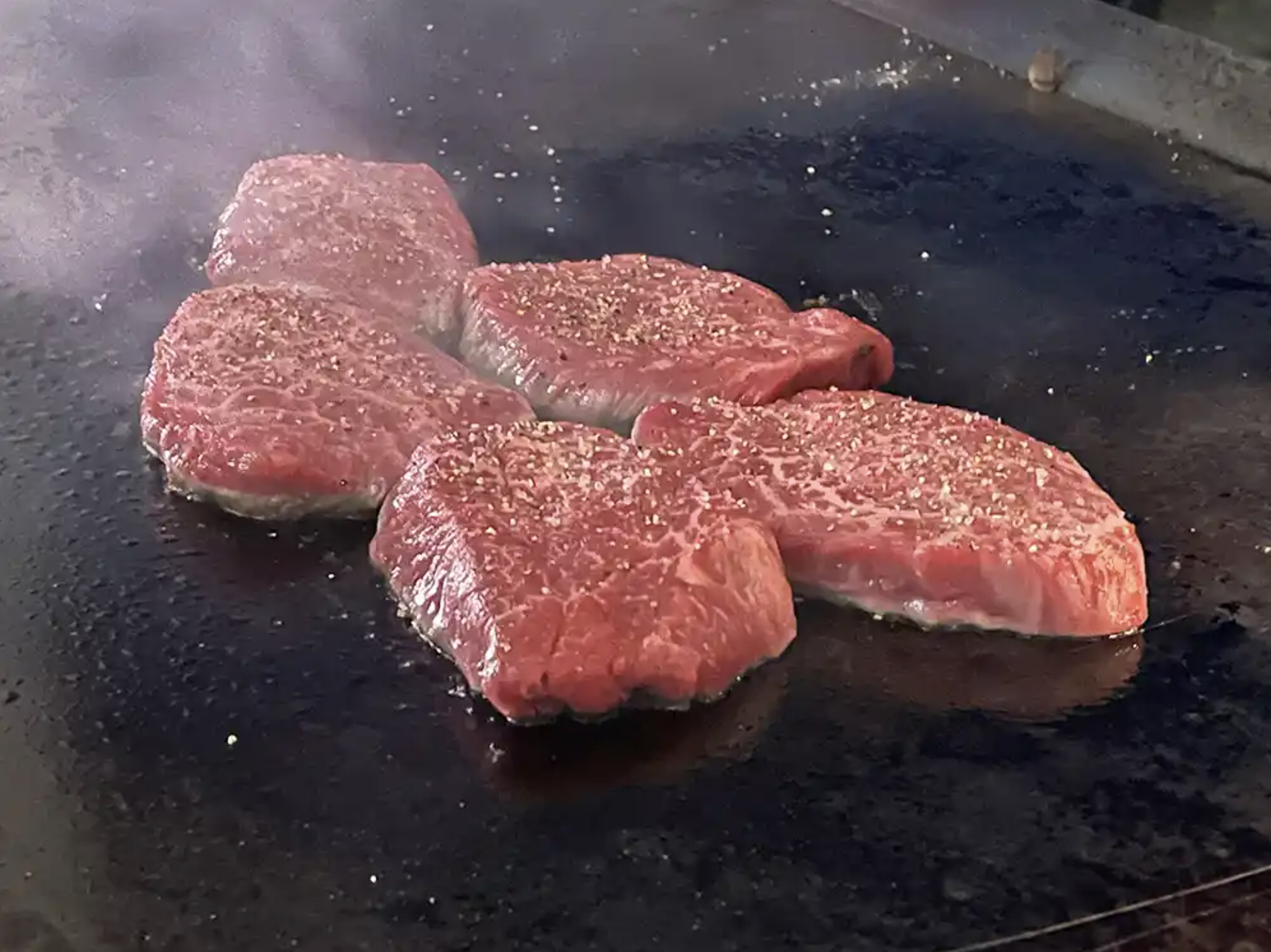
Steak bought at Niku no Utopia
Day two began with an optional nature walk at Ainosawa Villagers’ Forest with a forest guide. During the hike, the guide gathered samples to measure for radiation, introducing the audience to the “researchers’ measuring hut” later on.
After the hike, the group visited Yamatsumi Shrine known for its wolf worship, and for the annual festival that was revived in a new form in 2025. The wolf paintings on the shrine ceiling were restored after two rounds of hardship, evacuation following the nuclear accident, and the loss of the shrine building to fire.
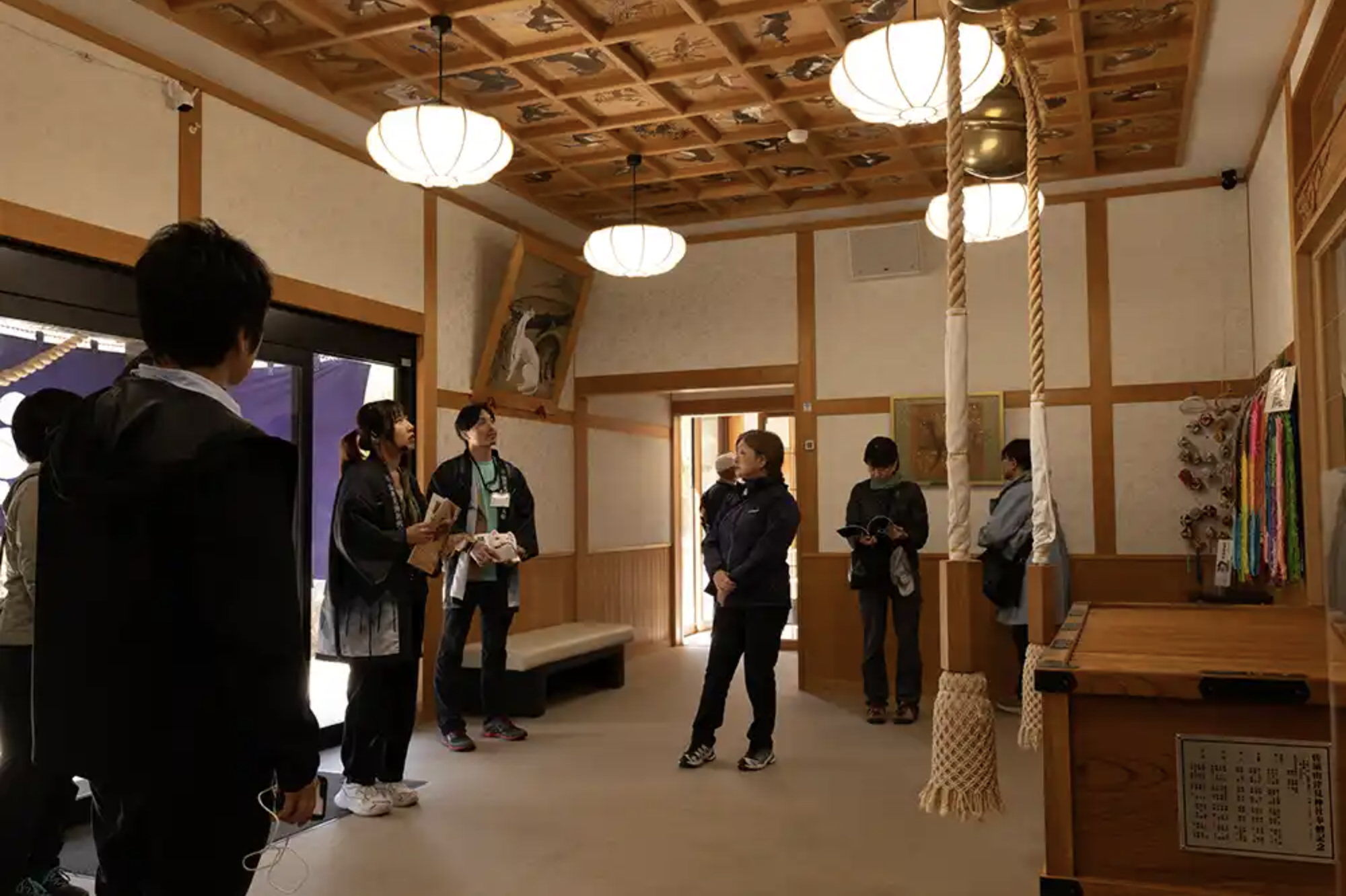
Looking up at the wolf ceiling paintings inside Yamatsumi Shrine
The main hall sits at the summit of Mount Toratori, and those who wanted to make the climb were able to. The trail, which doubles as the shrine approach, is the setting of a legend in which Minamoto no Yoriyoshi was guided by a white wolf as he set out to capture the local bandit Tachibana no Sumitora. At the entrance to the approach, visitors are greeted by a wolf bench that has been traveling to the area from the site of Expo 2025 Osaka, Kansai.
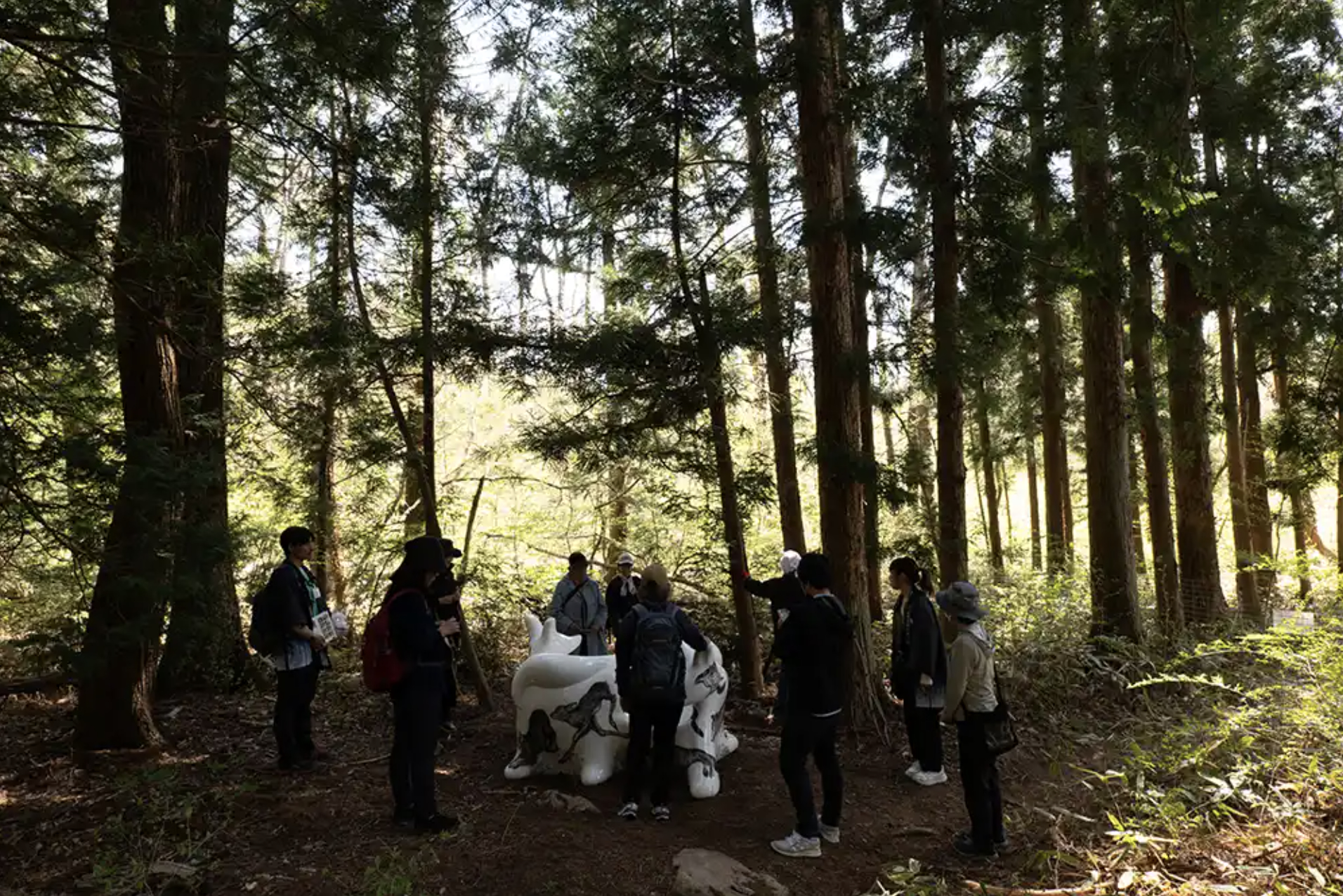
The group around Tomoko Konoike’s Animal Drawings (2025)
After the climb, lunch was at Kimagure Chaya Chieko, a country-cooking restaurant in an old house not far from Yamatsumi Shrine. From there, Yoichi Tao, chairman of the certified NPO Resurrection of Fukushima, joined the group and led the way to the “researchers’ measuring hut” that serves as the organization’s base.
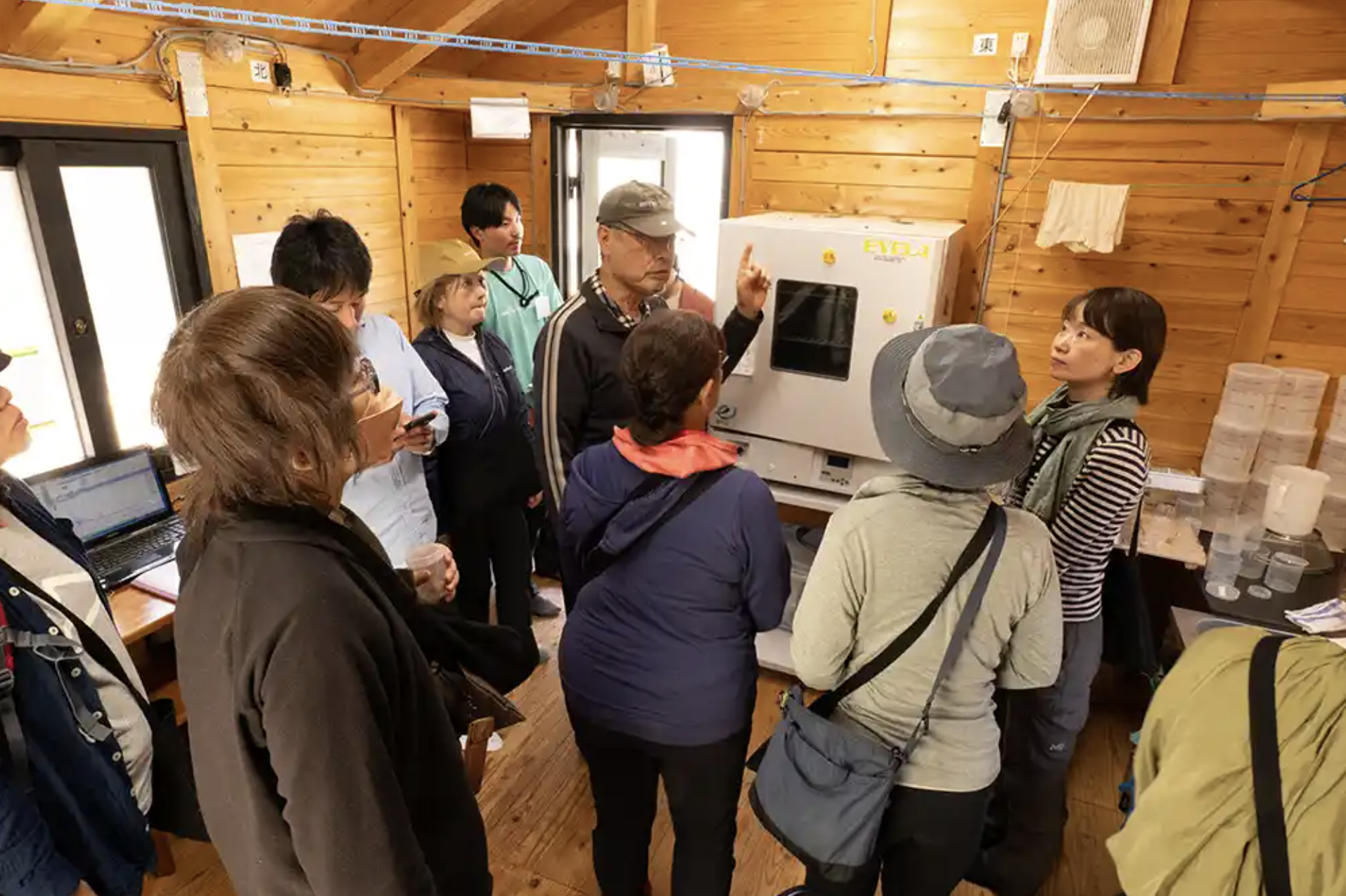
Listening to Yoichi Tao (center) at the researchers’ measuring hut.
Over many years of work, this hut has been used to measure radiation in crops and in a wide range of environmental samples. On this tour, radiation levels were measured for the items collected at Ainosawa and Mount Toratori. Explanations drawing on past measurement data made it possible to see what lies behind the figures and graphs on the screen.
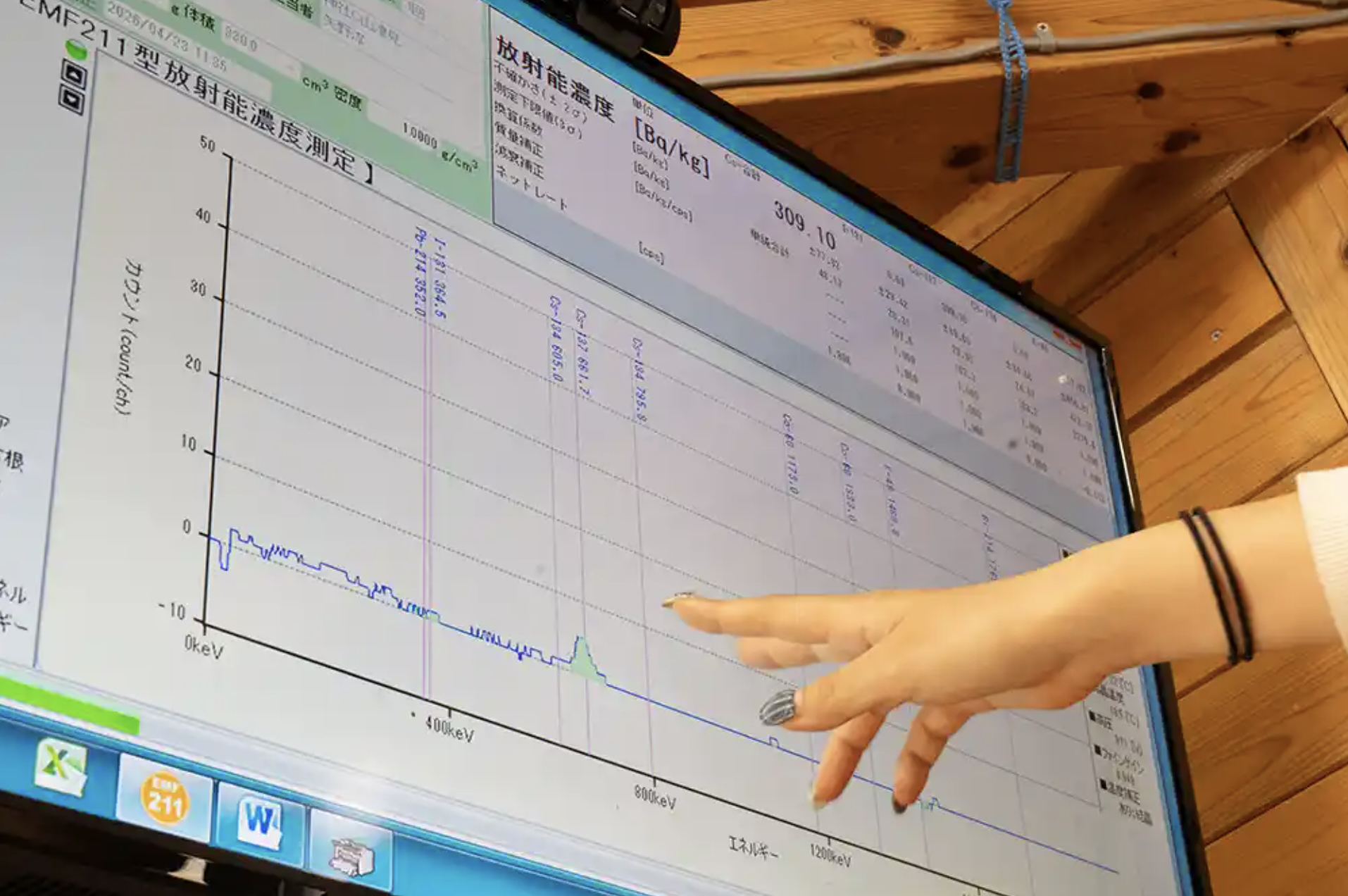
Yoichi Tao shared the organization’s journey since 2011, detailing their extensive environmental radiation monitoring alongside the fresh exchanges and initiatives spawned by these efforts, offering insights that are deeply appreciated by the community.
Inspired by this grassroots collaboration among locals, scientists, and volunteers, the tour proceeded with a 30-minute drive south across the village to the Nagadoro district, the focal site of an ongoing national environmental regeneration project.
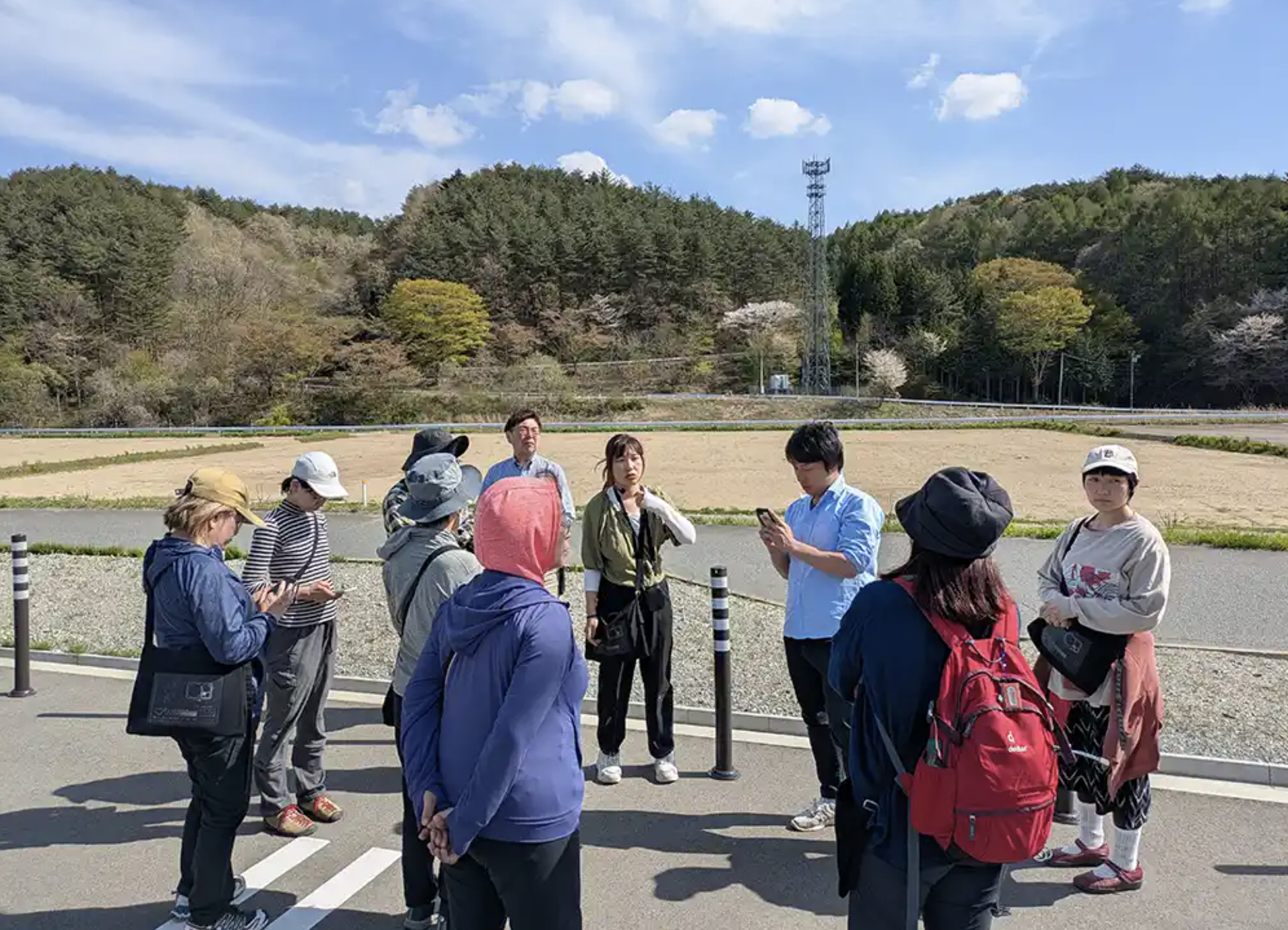
In the Nagadoro district
In the district of Nagadoro, a sophisticated soil decontamination process is underway, where soil removed during village-wide remediation is carefully repurposed into recycled embankment fill. This initiative represents a deliberate act of environmental restoration, reshaping the Satoyama landscape through human-led ecological remediation that actively works to reconcile and heal the local human-nature relationship.
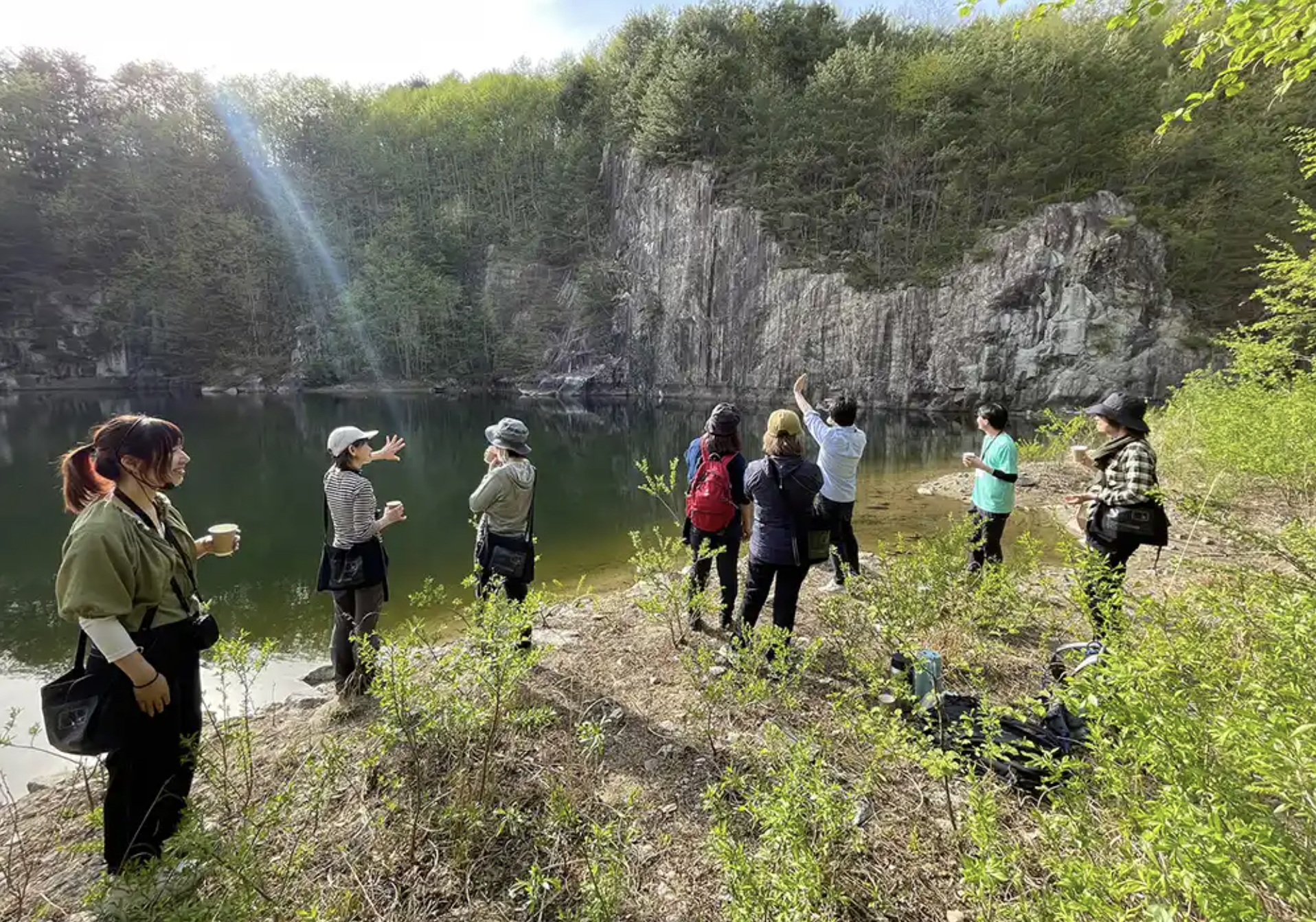
The former quarry at Hiso
The trips FabCafe Fukushima produces do not come together through Iitate’s environment and the lives of its people alone. The curiosity each participant carries acts as a bridge back to the Traveling the Umwelt exhibition encountered at the tour’s start. By connecting the cosmic scale of the planetary observatory to the hyper-local soil stewardship of the village farms, the tour serves as a practical application of the exhibition’s multi-scalar theme, allowing visitors to practice this expansive perspective within the living museum of the real world.
Building on the multi-scalar perspective of these learning tours, FabCafe Fukushima offers a variety of tailored programs to support deeper engagement. Options include the “Umwelt Exploration Travelogue,” which investigates the Iitate environment through artistic and theatrical lenses, as well as customized group training designed for collaborative dialogue and problem-solving. For more information on these services, please visit the FabCafe Fukushima Services page to discuss how a program can be designed for your needs.
[*1] Tour operated by Kaze Travel. Produced by Zutto Soko Inc.


-
FabCafe Global Editorial Team
This articles is edited by FabCafe Global.
Please feel free to share your thoughts and opinions on this article with us.
→ Contact usThis articles is edited by FabCafe Global.
Please feel free to share your thoughts and opinions on this article with us.
→ Contact us -


See Branch List
See Keyword List
- #Craft
- #crQlr
- #HK Event Report
- #COUNTER_POINT
- #Prototyping
- #Design thinking workshop
- #SDG 14 Life under water
- #Miro
- #Creator Collaboration
- #Bangkok Design Week 2020
- #FabCafe Bangkok
- #Fab Meetup Hong Kong
- #FAB Ideation
- #Future City
- #COVID-19
- #Event Report
- #Sustainable
- #Business
- #Social Welfare
- #Fab Meetup
- #Exhibition
- #Art
- #SDGs
- #Haptic Design
- #Material
- #Drawing
- #Wood
- #Hackathon
- #AI
- #Agriculture
- #YouFab
- #Workshop
- #Meetup
- #AWRD
- #Bio
- #Global Goals Jam
- #XR (VR/AR/MR)
- #Talk Event
- #Ideathon
- #Embroidery
- #Material Meetup
- #Innovation
- #Architecture
- #Interview
- #Education
- #3D
- #Business Projects
- #Community